
Introduction
In recent years, interest in family history and identity has surged across the United States. More people than ever are ordering at-home kits to discover where their ancestors came from and how their family story fits into world history. When those results arrive, however, many beginners feel confused. Percentages, regions, and changing updates can make DNA ethnicity results seem complicated at first glance.
A DNA ancestry test does not simply tell you “who you are.” Instead, it provides a scientific comparison between your DNA and reference populations from around the world. For Americans—whose family roots often span multiple continents—these reports can reveal surprising connections, migrations, and shared heritage.
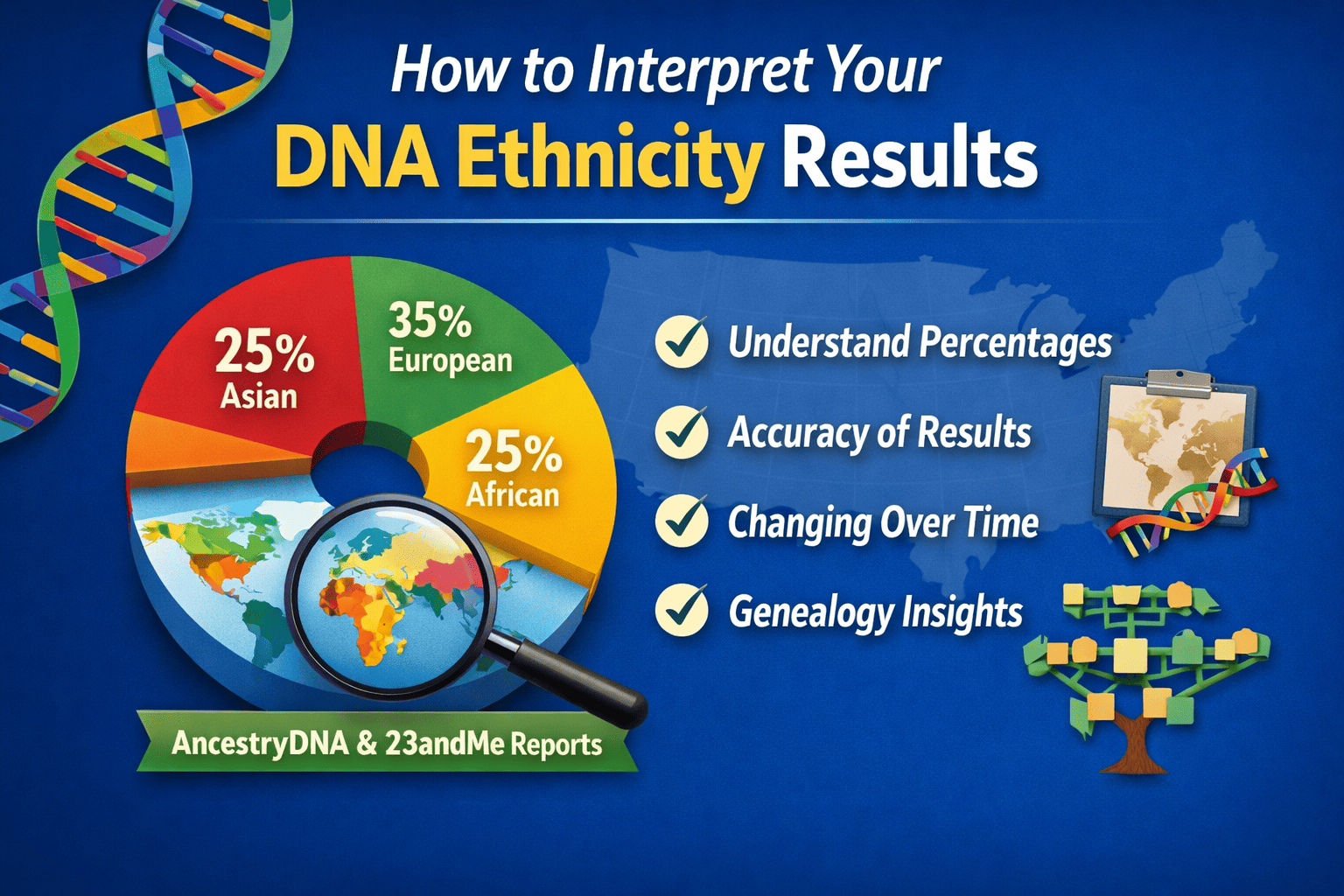
This guide is designed to help you clearly understand your ethnicity estimate, avoid common misunderstandings, and confidently use your results for genealogy research. Written in simple language and focused on real users, this article explains how ethnicity reports work, why they change, and how to interpret them correctly—so you can turn raw data into meaningful family insights.
What Are DNA Ethnicity Results?
DNA ethnicity results are a breakdown of your ancestral origins based on your DNA. Testing companies analyze thousands of markers in your genetic code and compare them to people from different regions around the world.
Your report typically shows:
- A list of geographic regions
- Estimated percentages for each region
- A map highlighting ancestral areas
It’s important to understand that these results reflect genetic ancestry, not nationality or culture. For example, having Irish ancestry in your DNA does not automatically mean your recent ancestors lived in Ireland—it means your DNA is similar to people whose families historically lived there.
Think of ethnicity results as probabilities, not absolute facts.
How DNA Ancestry Tests Calculate Ethnicity
A DNA ancestry test works by comparing your DNA to reference panels—large databases of people whose families have lived in the same regions for generations.
Here’s the simplified process:
- You provide a saliva sample.
- The lab analyzes specific DNA markers.
- Your DNA is compared to global reference populations.
- Algorithms calculate similarities and differences.
- You receive an ethnicity estimate based on statistical matches.
Because reference panels grow and improve, results may evolve over time. This does not mean your DNA has changed—only the science interpreting it has improved.
Understanding DNA Ethnicity Percentages
Many people focus heavily on DNA ethnicity percentages, but these numbers are often misunderstood. A percentage does not mean a direct ancestor from that region at a specific generation.
For example:
- 50% typically suggests a parent-level connection
- 25% may point to a grandparent
- Small percentages (1–5%) often reflect distant ancestry
A DNA ethnicity breakdown is best viewed as a range rather than a fixed number. Testing companies often include confidence intervals that show how estimates may shift slightly.
The key takeaway: percentages show likelihood, not certainty.
Why DNA Ethnicity Results Change Over Time
One of the most common surprises is seeing DNA ethnicity results update months or years later. This happens for several reasons:
- Expanded reference populations
- Improved algorithms
- Better regional definitions
- Increased global data accuracy
Changes are usually small, such as 3–5% shifting between neighboring regions. These updates improve accuracy rather than contradict earlier findings.
For users in the USA with mixed heritage, updates can actually clarify complex ancestral histories.
Interpreting AncestryDNA & 23andMe Ethnicity Reports
Two of the most popular services in the United States are AncestryDNA ethnicity reports and 23andMe ethnicity results.
AncestryDNA
- Strong focus on historical regions
- Frequent updates
- Excellent tools for family tree research
23andMe
- Combines ethnicity with health insights
- Detailed regional breakdowns
- Scientific explanations of estimates
While both companies analyze similar genetic data, their methods and reference panels differ. That’s why the same person may see slightly different DNA ethnicity breakdown results across platforms.
How Accurate Are DNA Ethnicity Results?
Many users ask: how accurate is DNA ethnicity testing?
The honest answer: accuracy depends on the region.
Highly researched regions (Europe, parts of Africa, East Asia) tend to be more precise. Regions with limited historical data may show broader estimates.
Key accuracy factors include:
- Size of reference population
- Genetic diversity of the region
- Algorithm quality
- Ongoing database updates
Overall, modern tests provide reliable insights into genetic ancestry, but they are best used as guides—not final answers.
Common Misunderstandings About DNA Ethnicity
Several myths lead to confusion:
- Myth: Small percentages are mistakes
Truth: They often represent distant ancestry. - Myth: Results identify specific ancestors
Truth: They show population-level similarities. - Myth: Ethnicity equals culture
Truth: Culture is learned; DNA reflects biology.
Understanding these points helps you read your ethnicity estimate with confidence and clarity.
How to Use DNA Ethnicity Results for Genealogy Research
Your DNA ethnicity results become far more powerful when combined with traditional genealogy research.
Practical steps:
- Compare ethnicity data with family records
- Use matches to confirm migration paths
- Focus on shared DNA matches
- Connect ethnicity regions with historical timelines
When used correctly, ethnicity data supports family tree research rather than replacing it. It provides context for where to search next.
FAQs: Quick Answers (AEO Section)
What do DNA ethnicity results really tell you?
They show genetic similarities to global populations, not exact ancestors.
Why do DNA ethnicity percentages change?
Updates happen as science and databases improve.
Can DNA tests prove ethnicity?
They estimate probability, not certainty.
Is one DNA ancestry test better than another?
Each has strengths; comparing multiple reports can offer deeper insight.
Conclusion + Call to Action
Interpreting DNA ethnicity results doesn’t require a science degree—just the right perspective. These reports are powerful tools for understanding heritage, migration, and identity, especially for families in the United States with diverse backgrounds.
Remember: your DNA tells a story of movement, adaptation, and shared humanity. Use your results thoughtfully, combine them with historical research, and stay open to updates as science advances.
If you’ve taken a test or are planning one, explore your genetic ancestry further, connect with relatives, and start building a richer, more accurate family history today.