
Introduction
In the last decade, at-home DNA testing has transformed the way people explore their family history. What once required years of research, travel, and guesswork can now begin with a simple saliva sample. For millions of Americans, DNA matches have opened doors to discovering unknown family connections, confirming long-held suspicions, and even reuniting biological families after decades apart.
Whether you are an adoptee searching for birth relatives, a family historian expanding a lineage, or a beginner curious about your roots, understanding how DNA relatives are identified is the first step. Thanks to advances in genetic genealogy, modern DNA testing services can compare your genetic data against massive databases to help you find relatives by DNA with surprising accuracy.
However, getting results is only part of the journey. Interpreting DNA ancestry results, understanding shared DNA, and reaching out to potential relatives requires knowledge, patience, and sensitivity. This guide walks you step by step through the process—clearly, ethically, and practically—so you can confidently use DNA testing to build connections and create a meaningful DNA family tree.
What Are DNA Matches?
DNA matches are people in a DNA testing database who share segments of genetic material with you. These shared segments indicate a common ancestor somewhere in your family line.
When you take a genealogy DNA test, the testing company compares your DNA with millions of others. If enough DNA is shared, the system flags that person as a potential relative.
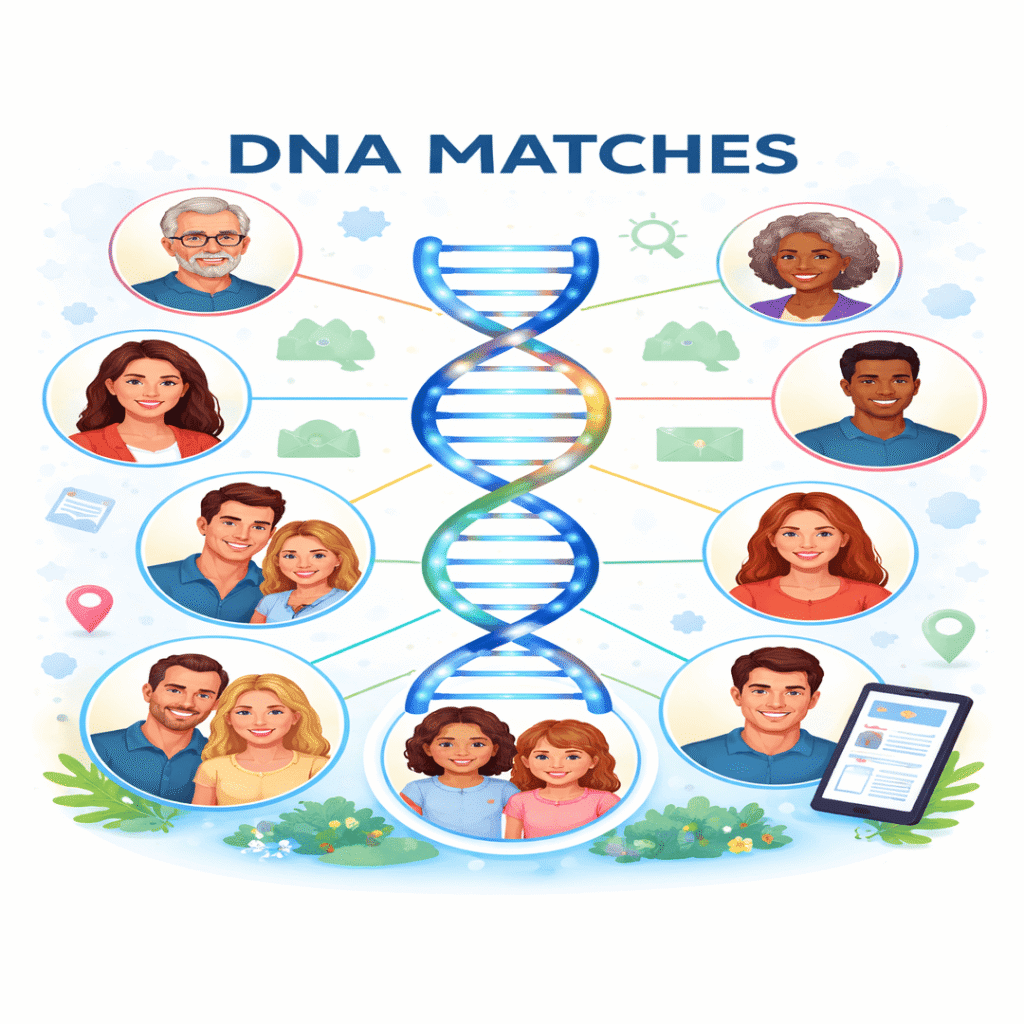
What DNA Matches Can Tell You
- Possible family relationships
- Shared ancestors
- Ethnic and regional heritage connections
- Clues to missing branches in your DNA family tree
These matches can range from very close (parents or siblings) to distant cousins you may never have heard of.
How DNA Matching Works
To truly find relatives by DNA, it helps to understand how DNA matching actually works behind the scenes.
Most consumer DNA tests analyze autosomal DNA—the type inherited from both parents. This allows testing companies to identify DNA cousin matches across many generations.
The DNA Matching Process
- You submit a saliva or cheek-swab sample
- The lab extracts and analyzes your DNA
- Your DNA is compared with others in the database
- The system identifies shared DNA matches
- Results appear in your dashboard within weeks
Each match is ranked by how much DNA you share, which helps estimate how closely related you might be.
Understanding Shared DNA and the Centimorgans Chart
One of the most important tools in genetic genealogy is the centimorgans chart. A centimorgan (cM) is a unit that measures how much DNA two people share.
The higher the centimorgan number, the closer the relationship.
Common Centimorgan Ranges
| Relationship | Approximate cM Range |
|---|---|
| Parent/Child | 3,400+ |
| Full Siblings | 2,300–2,800 |
| Grandparent | 1,300–2,300 |
| First Cousin | 575–1,330 |
| Second Cousin | 200–575 |
| Distant Cousin | Under 200 |
By combining centimorgan data with shared DNA matches, you can narrow down where someone fits in your family structure and strengthen your DNA family tree.
Identifying Close vs Distant DNA Relatives
Not all DNA relatives require the same approach. Understanding relationship distance helps you decide where to focus your energy.
Close DNA Relatives
- Parents
- Siblings
- Grandparents
- Aunts and uncles
These matches usually share large DNA segments and are easier to identify using DNA ancestry results and family trees.
Distant DNA Relatives
- Second to fifth cousins
- Relatives several generations back
These DNA cousin matches require more research, record comparison, and patience—but they can still unlock important ancestral clues.
Step-by-Step: How to Find Relatives Using DNA Matches
Step 1: Review Your DNA Matches Carefully
Start by sorting your DNA matches by shared centimorgans. Focus on the highest matches first, as they represent closer relationships.
Step 2: Study Shared Matches
Look for shared DNA matches—people who match both you and another individual. These clusters often represent a shared ancestral line.
Step 3: Build or Expand Your DNA Family Tree
Use names, locations, and dates from matches to grow your DNA family tree. Even partial information can reveal patterns.
Step 4: Compare DNA Ancestry Results
Ethnicity overlaps in DNA ancestry results can help confirm family connections, especially for distant relatives.
Step 5: Reach Out Thoughtfully
Send a short, respectful message introducing yourself. Mention shared DNA and ask if they are open to comparing family history.
How to Contact DNA Matches Safely
Connecting with DNA relatives can be life-changing—but it should always be done carefully and ethically.
Best Practices for Outreach
- Be polite and non-intrusive
- Avoid assumptions about relationships
- Respect privacy and boundaries
- Share only basic information initially
Remember, not everyone who takes a genealogy DNA test is actively looking for family connections.
Common Mistakes to Avoid
Even experienced researchers can make errors when working with DNA matches.
Mistakes to Watch Out For
- Assuming relationships without evidence
- Ignoring the centimorgans chart
- Overlooking shared DNA matches
- Relying only on ethnicity estimates
- Sending overly emotional first messages
Avoiding these mistakes improves accuracy and preserves trust with DNA relatives.
Privacy and Ethical Considerations
Using DNA data responsibly is a core principle of genetic genealogy.
Ethical Guidelines
- Respect consent and confidentiality
- Avoid sharing others’ information publicly
- Be cautious with sensitive discoveries
- Understand data-sharing settings
While DNA testing helps you find relatives by DNA, it also carries responsibility toward the people involved.
Frequently Asked Questions (People Also Ask)
Can DNA matches really help me find biological family?
Yes. DNA matches have successfully helped thousands of people identify biological parents, siblings, and extended DNA relatives.
How accurate are DNA cousin matches?
DNA cousin matches are generally accurate but require confirmation through records, family trees, and shared DNA matches.
What if my DNA ancestry results don’t match my expectations?
Unexpected DNA ancestry results are common and often reveal hidden family history or migration patterns.
Do I need to build a family tree to use DNA matches?
While not required, building a DNA family tree greatly improves your ability to interpret results and identify connections.
Practical Tips from Real-World Research
- Keep a research log to track DNA matches
- Use surnames and locations to group DNA relatives
- Revisit matches periodically as databases grow
- Combine paper records with genetic genealogy tools
Small, consistent efforts often lead to major breakthroughs.
Conclusion: Turning DNA Matches into Meaningful Connections
Learning how to find relatives through DNA testing is both exciting and deeply personal. With the right approach, DNA matches can help uncover long-lost family connections, clarify ancestry, and build a richer understanding of your past.
By understanding centimorgans, analyzing shared DNA matches, and applying ethical communication practices, you can confidently navigate your results and grow a reliable DNA family tree. Whether your goal is personal discovery or serious research, DNA testing is a powerful tool when used thoughtfully.
Ready to begin? Review your DNA ancestry results, study your top matches, and take the first respectful step toward discovering your family story—one connection at a time.